Accessing the User Groups Feature
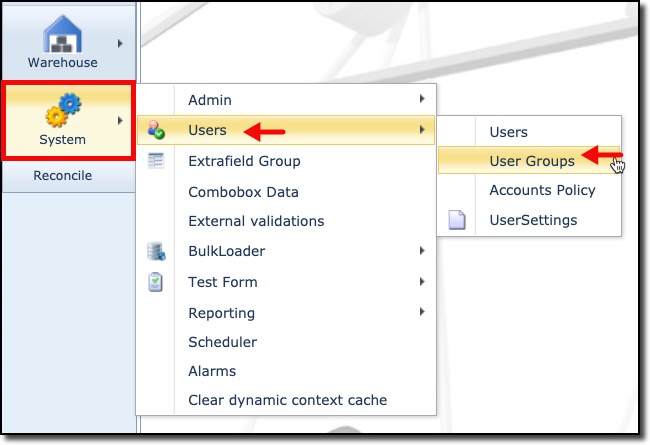
From the IMS Main menu bar:
▪ |
Click on the System icon |
▪ |
In the following dropdown list, select Users and then User groups |
The UserForm Actions tab with an empty User tab form is displayed.
There are some important concepts to understand on how User Access Control is implemented in IMS.
The following shows various components that combine to create a User Group that a User is then added to. The areas in red are set by default in the IMS system, the blue areas are set by the IMS administrators – typically implementation teams.
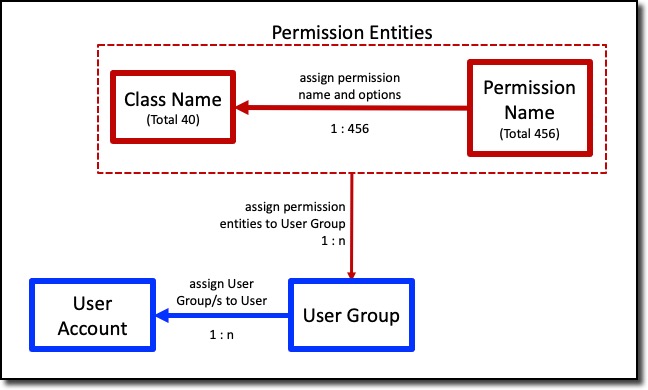
A User Groups is characterized by its role and function in the network and is typically driven by the business case or department i.e., Network Administration, Service Provisioning, Network and Services Design Team, Financial/Accounts Group, etc.
Once these User Groups are set up and their permission options selected (by default all Permission Entities are unselected), then User Accounts can be associated with their respective User Group or User Groups.
A User Account must be associated to at least one User Group in order to login to IMS.
Limiting a User Group by Entity Types
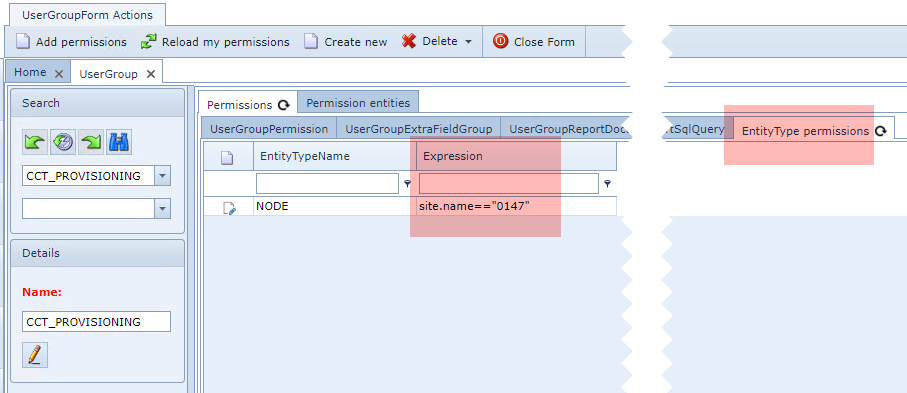
The function UserGroupEntityTypePermission can be used to apply a filter to limit user's access to IMS Entities by their types i.e., Site, Equipment, etc. This filtering is achieved by means of applying a filter expression in the EntityType Permissions tab located in the UserGroup Form. These filters are then applied at lookup time and in information grids for those particular User Group members.
The next screen shot gives an example of limiting a User Group called Circuit Provisioning, to IMS entity types of Node and where their location name is equal to 0147 (record identifier).
User belongs to more than one User Group
Should an IMS user belong to more than one User Group, and if each User Group has its own Expression filter, then the OR logical operator is invoked.
Example:
User X belongs to UserGroup1, which has an expression of site.name=="0147", and UserGroup2, which has an expression of site.name=="0148".
The applied expression will be: (site.name=="0147") || (site.name=="0148")